

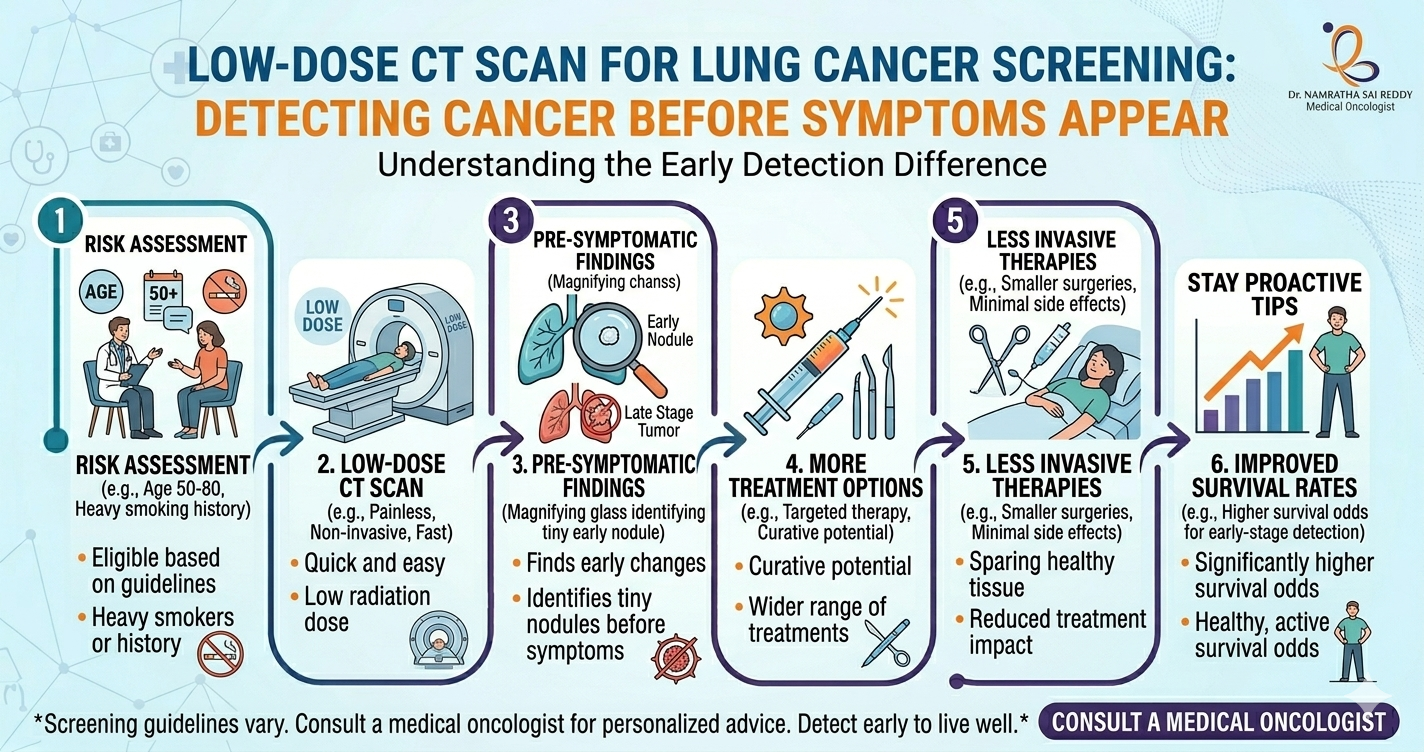
Lung cancer remains one of the most serious global health challenges. One major reason is that the disease often develops without noticeable symptoms in its early stages, leading to delayed diagnosis and limited treatment options.
Advances in medical imaging have changed this reality. One of the most important breakthroughs in cancer screening is the Low-Dose CT (LDCT) scan, which allows doctors to detect lung cancer much earlier than traditional methods.
Research has shown that screening high-risk individuals with LDCT can reduce lung-cancer deaths by about 20% compared with chest X-rays, demonstrating the powerful role of early detection in saving lives.
Key Takeaways
- Low-dose CT scans can detect lung cancer at an early stage.
- Screening significantly reduces lung-cancer mortality in high-risk individuals.
- The scan is quick, painless, and non-invasive.
- High-risk individuals, particularly smokers, benefit most from screening.
- Early detection allows more effective and potentially curative treatments.
What Is a Low-Dose CT Scan for Lung Cancer Screening?
A low-dose CT scan is a specialised imaging test designed to detect lung cancer in people who are at higher risk of developing the disease. Unlike a standard CT scan, LDCT uses significantly less radiation while still producing detailed images of the lungs.
This enables doctors to detect very small nodules or abnormalities that may indicate early cancer, often before symptoms appear.
How the technology works
Low-dose CT scans use advanced imaging technology to capture multiple cross-sectional images of the lungs from different angles. A computer then processes these images to create a detailed view of lung tissue.
This level of precision allows doctors to detect nodules as small as a few millimetres in size, which would typically not be visible on a standard chest X-ray.
Key features of LDCT screening
- Uses lower radiation doses than conventional CT scans
- Produces highly detailed lung images
- Detects abnormalities at a very early stage
- Suitable for routine screening in high-risk individuals
Because lung cancer often progresses silently, this technology has become one of the most valuable tools in early cancer detection.
Why Is Early Detection of Lung Cancer So Important?
Early detection dramatically improves survival rates. Lung cancer often does not cause noticeable symptoms until the disease has progressed. When symptoms such as persistent cough, chest pain, fatigue, or weight loss appear, the cancer may already have spread.
Detecting lung cancer earlier can significantly improve treatment outcomes.
Statistics highlighting the importance of early detection
- The American Lung Association reports that the five-year survival rate for lung cancer increases significantly when the disease is detected at an early stage.
- According to research from the National Cancer Institute, low-dose CT screening reduces lung-cancer deaths by approximately 20% in high-risk populations.
- Global cancer data compiled by the International Agency for Research on Cancer shows that lung cancer remains the leading cause of cancer-related deaths worldwide, emphasising the need for better screening strategies.
Benefits of detecting cancer early
Early diagnosis may allow doctors to:
- Remove tumours surgically before they spread
- Use less aggressive treatments
- Improve long-term survival rates
- Reduce complications associated with advanced disease
For many patients, early detection can mean the difference between curative treatment and complex long-term management.
Who Should Consider Low-Dose CT Screening?
Adults at high risk, especially long-term smokers. Not everyone requires lung cancer screening. The benefits of LDCT screening are greatest in individuals with higher risk factors, particularly long-term smokers.
Recommended screening group
Medical guidelines generally recommend screening for individuals who:
- Are between 50 and 80 years of age
- Currently smoke or quit smoking within the past 15 years
- Have a smoking history of at least 20 pack-years
Understanding pack-years
A pack-year is a measurement used to estimate long-term smoking exposure.
Examples include:
- Smoking one pack per day for 20 years
- Smoking two packs per day for 10 years
Both scenarios equal 20 pack-years of smoking exposure.
Other potential risk factors
Some individuals may also have an elevated risk due to:
- Exposure to secondhand smoke
- Occupational exposure to carcinogens such as asbestos
- Long-term exposure to air pollution
- Family history of lung cancer
- Radon exposure in indoor environments
A healthcare provider can help determine whether screening is appropriate based on individual risk factors.
What Happens During a Low-Dose CT Scan?
A fast, painless imaging test of the lungs. Many patients feel anxious before undergoing imaging tests. However, the low-dose CT scan is simple, quick, and painless.
Step-by-step overview
- The patient lies on a motorised scanning table.
- The technologist positions the patient comfortably.
- The table slowly moves through the CT scanner.
- The scanner captures multiple images of the lungs.
The entire process usually takes less than 10 minutes, and no recovery time is needed.
Important features of the procedure
- No needles or injections required
- No contrast dye needed
- Minimal preparation before the test
- Patients can resume normal activities immediately afterwards
Because of its simplicity and low radiation exposure, LDCT is considered safe for annual screening in eligible individuals.
What Can a Low-Dose CT Scan Detect?
Tiny nodules and early signs of lung cancer. One of the biggest advantages of LDCT scans is their ability to detect very small lung abnormalities that may not appear on standard imaging tests.
Possible findings on the scan
- Small lung nodules
- Early lung tumors
- Lung inflammation or infection
- Scar tissue
- Other lung conditions, such as emphysema
It is important to understand that most lung nodules detected during screening are not cancerous.
What happens if a nodule is detected?
If an abnormality appears on the scan, doctors may recommend:
- Repeat CT scans after several months
- Additional imaging tests, such as PET scans
- Biopsy if the nodule appears suspicious
Careful monitoring helps determine whether a nodule is harmless or requires further evaluation.
What Are the Benefits of Low-Dose CT Screening?
Low-dose CT screening offers several important advantages, especially for individuals at higher risk.
Major benefits include
Early cancer detection
The scan can detect tumours before symptoms develop, improving treatment success.
Improved survival rates
Early-stage lung cancer is often more treatable and may be cured through surgery.
Non-invasive procedure
The screening test is quick, painless, and does not require hospitalisation.
Better monitoring of lung health
The scan may also detect other lung conditions that require medical attention.
Are There Any Risks or Limitations?
While LDCT screening provides many benefits, it is important to understand potential limitations.
False positives
Sometimes scans may detect nodules that appear suspicious but are not cancerous. This may require additional testing.
Radiation exposure
Although the radiation dose in LDCT scans is significantly lower than that of standard CT scans, repeated imaging over time may increase cumulative exposure.
Overdiagnosis
In rare cases, screening may detect very slow-growing cancers that might not have caused symptoms during a person’s lifetime.
Because of these factors, screening is recommended primarily for individuals who meet established risk criteria.
How Can People Reduce Their Risk of Lung Cancer?
While screening helps detect cancer early, prevention remains the most effective strategy. Avoid smoking and maintain healthy habits.
Steps that reduce lung cancer risk
- Quit smoking or avoid tobacco use
- Avoid secondhand smoke exposure
- Maintain regular health check-ups
- Reduce exposure to environmental pollutants
- Follow medical advice for lung health monitoring
Combining preventive measures with appropriate screening provides the best protection against lung cancer.
Prioritize Prevention and Early Detection for Better Lung Health
Low-dose CT scans represent a major advancement in the early detection of lung cancer. By identifying abnormalities before symptoms appear, this screening method allows doctors to intervene earlier and improve treatment outcomes.
For individuals with a significant smoking history or other risk factors, discussing low-dose CT screening with a healthcare professional may be an important step toward protecting long-term health.
Early detection not only improves survival rates but also offers patients a better chance at effective treatment and recovery.
Frequently Asked Questions (FAQs)
1. What is a low-dose CT scan?
A low-dose CT scan is an imaging test that uses minimal radiation to detect early lung abnormalities that may indicate cancer.
2. Who should undergo lung cancer screening?
Adults aged 50–80 with a significant smoking history or those who quit smoking within the past 15 years are typically recommended for screening.
3. Is the low-dose CT scan painful?
No, the scan is painless and usually completed within a few minutes.
4. How often should screening be done?
Most guidelines recommend annual screening for individuals who meet the eligibility criteria.
5. What are lung nodules?
Lung nodules are small, round growths in the lungs. Many are benign and require only monitoring.
6. Does a detected nodule mean cancer?
No. Most nodules found during screening are non-cancerous.
7. Is radiation exposure from LDCT dangerous?
The radiation dose is low and considered safe for screening when recommended by a doctor.
8. Can non-smokers develop lung cancer?
Yes, although smoking is the primary risk factor, lung cancer can also occur due to environmental exposures and genetic factors.
9. What happens if an abnormality is detected?
Doctors may recommend follow-up imaging, monitoring, or further diagnostic tests.
10. Can lung cancer screening prevent cancer?
Screening cannot prevent cancer, but can detect it early, improving treatment success and survival.