
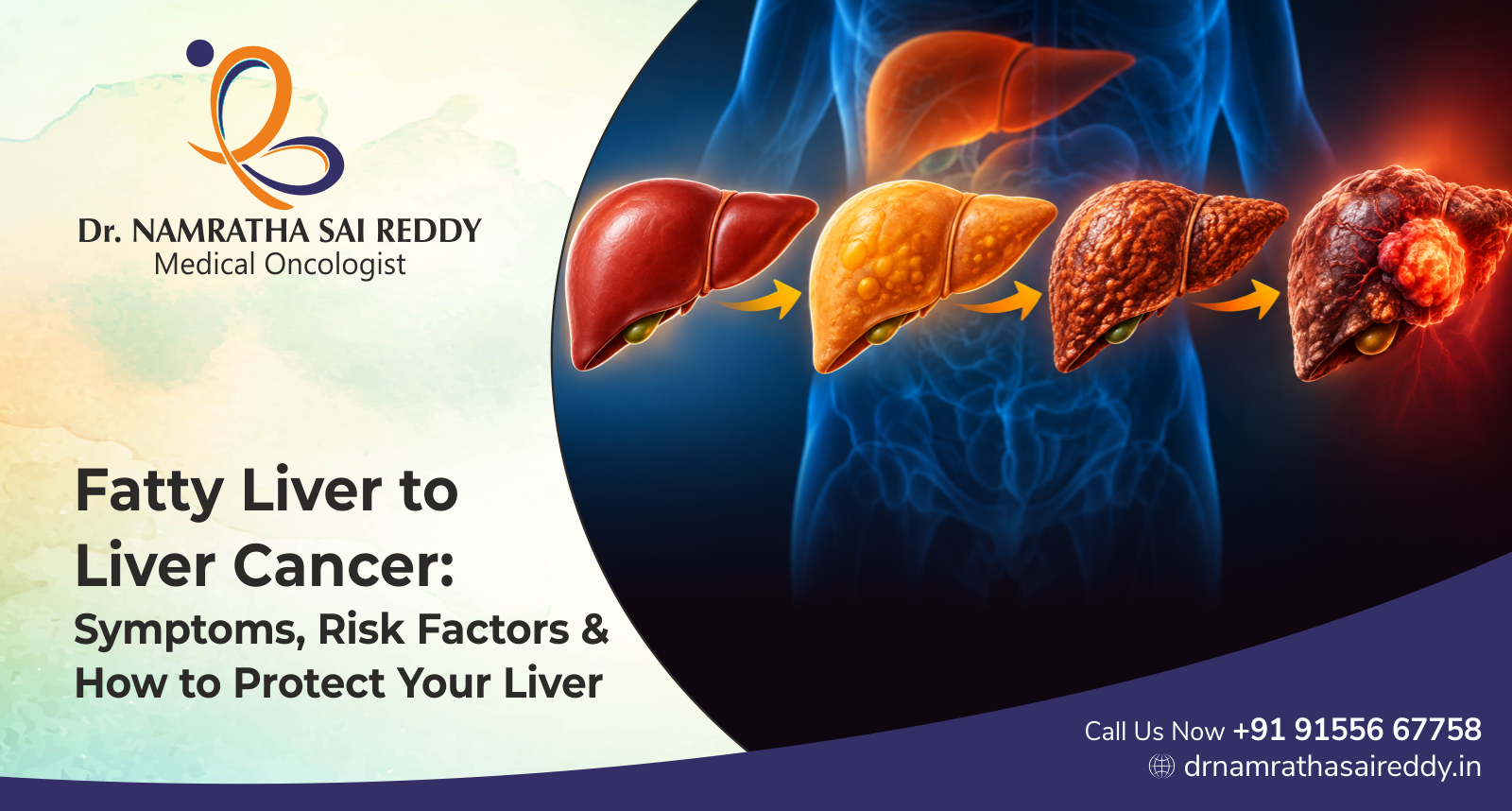
Fatty liver disease is among the most common conditions affecting adults today, yet most people dismiss it as a minor inconvenience rather than a potential gateway to something far more serious. What begins as excess fat accumulating in liver cells can, over years and decades, quietly progress through inflammation, scarring, and cirrhosis before arriving at hepatocellular carcinoma, the most common form of liver cancer. This article explains how and why that progression happens, what symptoms to watch for at each stage, and what you can do now to protect your liver before damage becomes irreversible. For related reading, see our article on obesity and cancer risk, and what survivorship care looks like once cancer is in remission.
Key Takeaways
- Fatty liver disease (MASLD) affects an estimated 25 to 30% of adults globally and is now the leading driver of liver disease worldwide.
- Most people with fatty liver have no symptoms; the condition is often discovered incidentally on an ultrasound or blood test.
- A subset of fatty liver cases progress to MASH (metabolic dysfunction-associated steatohepatitis), cirrhosis, and ultimately hepatocellular carcinoma (HCC), the most common primary liver cancer.
- Type 2 diabetes, obesity, high triglycerides, and heavy alcohol use are the strongest modifiable risk factors for this progression.
- Liver cancer that is detected early, before it spreads beyond the liver, has significantly better treatment outcomes than advanced disease.
- Lifestyle changes including weight loss, dietary improvement, and alcohol cessation can meaningfully reverse early-stage fatty liver and reduce cancer risk.
What Is Fatty Liver Disease and Why Does It Matter?
Fatty liver disease, now formally called metabolic dysfunction-associated steatotic liver disease (MASLD), occurs when more than 5% of the liver’s weight is made up of fat. In most cases, the liver continues to function adequately and the condition produces no symptoms. But the liver is not a passive bystander. When fat accumulates continuously, it can trigger a low-grade inflammatory response inside the liver tissue, a condition called metabolic dysfunction-associated steatohepatitis (MASH, formerly NASH). Over time, that inflammation causes liver cells to die and be replaced by fibrous scar tissue, a process called fibrosis. When fibrosis becomes extensive and widespread, the liver loses its normal architecture and function. This is cirrhosis.
According to the World Health Organization, liver cancer is the sixth most commonly diagnosed cancer and the third leading cause of cancer-related deaths worldwide. In India, liver cancer incidence has been rising steadily, driven in part by the growing burden of metabolic disease, viral hepatitis, and alcohol-related liver damage.
What Are the Symptoms of Fatty Liver Disease?
Simple fatty liver (MASLD without inflammation) is almost always silent. Most people who have it do not know until a routine blood test reveals mildly elevated liver enzymes or an abdominal ultrasound done for another reason shows a bright, echogenic liver. As fatty liver progresses toward MASH and fibrosis, symptoms may begin to emerge, though they remain nonspecific:
- Persistent fatigue that does not resolve with rest
- A vague discomfort or heaviness in the upper right abdomen
- Mild nausea, especially after fatty or heavy meals
- Unexplained weight gain concentrated around the abdomen
By the time cirrhosis develops, symptoms become more pronounced:
- Significant abdominal swelling from fluid accumulation (ascites)
- Jaundice, which is yellowing of the skin and whites of the eyes
- Swelling in the legs and ankles
- Easy bruising or prolonged bleeding from minor cuts
- Confusion or difficulty concentrating (hepatic encephalopathy)
- Dark urine and pale or clay-coloured stools
What to avoid: Do not wait for symptoms to appear before getting your liver health checked. See our guide on the importance of regular health check-ups for cancer prevention. By the time liver cancer causes noticeable symptoms, it has often already advanced to a stage where curative treatment is more difficult.
What Are the Early Signs of Liver Cancer?
- Unexplained and unintentional weight loss
- Loss of appetite, often accompanied by a persistent feeling of fullness after small meals
- Pain or tenderness in the upper right abdomen or near the right shoulder blade
- A palpable lump or fullness beneath the right rib cage
- Worsening jaundice in someone already diagnosed with liver disease
- New or worsening ascites in a known cirrhosis patient
- Generalised fatigue and weakness that progressively worsens
Who Is Most at Risk of Progressing from Fatty Liver to Liver Cancer?
Not everyone with fatty liver will develop liver cancer. Obesity is one of the strongest modifiable risk factors and significantly accelerates the progression from fatty liver to MASH and cirrhosis. Other major risk factors include:
- Type 2 diabetes or insulin resistance: People with type 2 diabetes have roughly double the risk of HCC compared to those without it.
- Cirrhosis from any cause: Approximately 80 to 90% of HCC cases arise in cirrhotic livers.
- Chronic hepatitis B or C infection: Viral hepatitis significantly accelerates liver injury. The combined effect on cancer risk with fatty liver is multiplicative, not merely additive.
- Heavy and prolonged alcohol use: Alcohol is directly toxic to liver cells and causes its own form of cirrhosis.
- Male sex and age over 50: HCC is approximately 2 to 3 times more common in men than women.
- Family history of liver cancer: A first-degree relative with HCC modestly elevates personal risk.
- High iron stores or haemochromatosis: Excess iron in the liver causes oxidative injury that accelerates fibrosis.
How Is Fatty Liver Progression and Liver Cancer Diagnosed?
Diagnosing fatty liver disease involves a layered approach. For context on how liquid biopsy and advanced blood tests are changing cancer detection, see our article on liquid biopsy and cancer detection.
- Blood tests: Liver function tests (LFTs), including ALT, AST, and GGT, can suggest liver inflammation. Platelet count and bilirubin levels can suggest cirrhosis.
- Abdominal ultrasound: The first-line imaging test for fatty liver. Detects fat accumulation and can identify suspicious liver masses.
- FibroScan (transient elastography): A non-invasive test that measures liver stiffness as a proxy for fibrosis.
- MRI and CT scanning: Used to characterise liver lesions, confirm HCC, and assess disease extent for staging.
- Liver biopsy: The most definitive method for staging fibrosis and confirming MASH.
- AFP (alpha-fetoprotein) blood test: A tumour marker used alongside ultrasound for HCC surveillance in high-risk patients, typically every six months.
How Can You Protect Your Liver and Reduce Liver Cancer Risk?
- Lose 7 to 10% of body weight if you are overweight: This level of weight loss can significantly reduce liver fat, inflammation, and fibrosis scores.
- Adopt a Mediterranean-style or low-refined-carbohydrate diet: Reducing sugar, white flour, and ultra-processed foods lowers liver fat.
- Eliminate or significantly reduce alcohol: There is no safe level of alcohol for someone with established liver fibrosis or cirrhosis.
- Control blood sugar: Good glycaemic control in people with type 2 diabetes reduces the metabolic drivers of liver inflammation.
- Exercise regularly: Both aerobic exercise and resistance training improve insulin sensitivity and reduce liver fat.
Get vaccinated against hepatitis B: One of the most effective liver cancer prevention measures available. See our article on vaccines for cancer survivors and prevention for related vaccination guidance.
- Undergo HCC surveillance if you have cirrhosis: Ultrasound plus AFP every six months is the standard of care.
- Avoid unnecessary over-the-counter painkillers: Paracetamol at high doses and NSAIDs are both hepatotoxic in existing liver disease.
How Is Liver Cancer Treated?
Treatment depends entirely on the stage of HCC and the patient’s overall health. For an overview of how targeted therapies differ from chemotherapy in cancer treatment, see our article on targeted therapy versus chemotherapy.
- Surgical resection: Removal of the tumour is the preferred option for early-stage HCC in patients with adequate liver reserve.
- Liver transplantation: For patients meeting Milan criteria (one tumour under 5 cm or up to three tumours each under 3 cm, no vascular invasion), transplantation offers both cancer treatment and cure for underlying cirrhosis.
- Ablation: Radiofrequency ablation (RFA) or microwave ablation destroys tumour tissue using heat.
- Transarterial chemoembolisation (TACE): Delivers chemotherapy directly to the liver tumour via its blood supply.
- Systemic therapy: Targeted therapies (sorafenib, lenvatinib) and immunotherapy combinations are now first-line for advanced HCC.
- Radiation therapy: Stereotactic body radiation therapy (SBRT) is increasingly used for tumours not amenable to ablation or resection.
Is This the Right Concern for You?
Liver cancer risk from fatty liver is real but not inevitable. Consult Dr. Namratha Sai Reddy’s clinic if you or a loved one is experiencing:
- Unexplained fatigue, upper abdominal discomfort, or jaundice
- A known diagnosis of fatty liver, MASH, or cirrhosis and questions about cancer risk
- Abnormal liver enzymes or imaging findings that need specialist review
- A family history of liver cancer or chronic hepatitis B or C
- Questions about whether HCC surveillance applies to your situation
When Should Liver Disease Patients Seek Urgent Medical Care?
- Sudden severe abdominal pain or rapid increase in abdominal swelling
- Vomiting blood or passing black, tarry stools (signs of variceal bleeding)
- New onset confusion, disorientation, or unusual behaviour in someone with cirrhosis
- Jaundice that appears rapidly or deepens over days
- High fever with abdominal tenderness (possible infected ascites)
- Sudden significant deterioration in energy or functional status
If any of these occur, go to the nearest emergency department or call emergency services immediately.
Medical References
- World Health Organization. Cancer Fact Sheet. Updated 2024.
- European Association for the Study of the Liver (EASL). Clinical Practice Guidelines on Non-Invasive Tests for Evaluation of Liver Disease Severity and Prognosis. Journal of Hepatology, 2021.
- American Association for the Study of Liver Diseases (AASLD). Practice Guidance on Prevention, Diagnosis, and Treatment of Hepatocellular Carcinoma. Hepatology, 2023.
- Rinella ME, et al. A multisociety Delphi consensus statement on new fatty liver disease nomenclature. Hepatology, 2023. PubMed.
- Kanwal F, et al. Risk of Hepatocellular Cancer in Patients With Non-Alcoholic Fatty Liver Disease. Gastroenterology, 2018. PubMed.
- Llovet JM, et al. Hepatocellular carcinoma. Nature Reviews Disease Primers, 2021. PubMed.
Frequently Asked Questions
1. Can fatty liver disease really lead to liver cancer?
Yes. While most fatty liver cases remain stable, a subset progresses through inflammation and scarring (cirrhosis) to hepatocellular carcinoma, the most common form of liver cancer. The risk is highest in patients who develop cirrhosis.
2. How long does it take for fatty liver to progress to liver cancer?
Progression from fatty liver to MASH to cirrhosis typically takes one to two decades, though metabolic risk factors like diabetes and obesity can accelerate it. Not all cases progress.
3. What are the first signs of liver cancer?
Early liver cancer often has no symptoms. When symptoms appear, they include unexplained weight loss, upper right abdominal pain or fullness, loss of appetite, and worsening jaundice in someone with known liver disease.
4. Is fatty liver reversible?
Yes. Early-stage fatty liver (without significant fibrosis) is reversible with sustained lifestyle changes including weight loss, dietary improvement, and alcohol cessation. Advanced fibrosis and cirrhosis are not fully reversible, though progression can be slowed.
5. Who should be screened for liver cancer?
Current guidelines recommend HCC surveillance with ultrasound and AFP testing every six months for all patients with cirrhosis, regardless of cause, and for certain high-risk patients with chronic hepatitis B even without cirrhosis.
6. Does alcohol cause fatty liver and liver cancer?
Yes. Alcohol is both a direct cause of fatty liver and an independent liver cancer risk factor. It also significantly worsens metabolic fatty liver disease when both conditions are present.
7. What diet is best for fatty liver?
A Mediterranean-style diet, rich in vegetables, legumes, whole grains, olive oil, and lean protein, with limited sugar and refined carbohydrates, has the strongest evidence for reducing liver fat and inflammation.
8. Can liver cancer be treated if caught early?
Yes. Early-stage HCC detected within transplant criteria or suitable for surgical resection or ablation has significantly better outcomes than advanced disease.
9. Are there medications for fatty liver?
Resmetirom (Rezdiffra) received FDA approval for MASH with moderate to advanced fibrosis, the first drug approved specifically for this indication. GLP-1 receptor agonists also show hepatic benefit. Consult a specialist for current options.
10. When should I see a doctor about my liver?
If you have risk factors such as obesity, type 2 diabetes, high triglycerides, heavy alcohol use, or known elevated liver enzymes, get a liver assessment even without symptoms. Early detection changes outcomes meaningfully.
This article is for informational purposes and does not replace professional medical advice. Always consult your oncologist before making decisions about your diagnosis or treatment plan.