

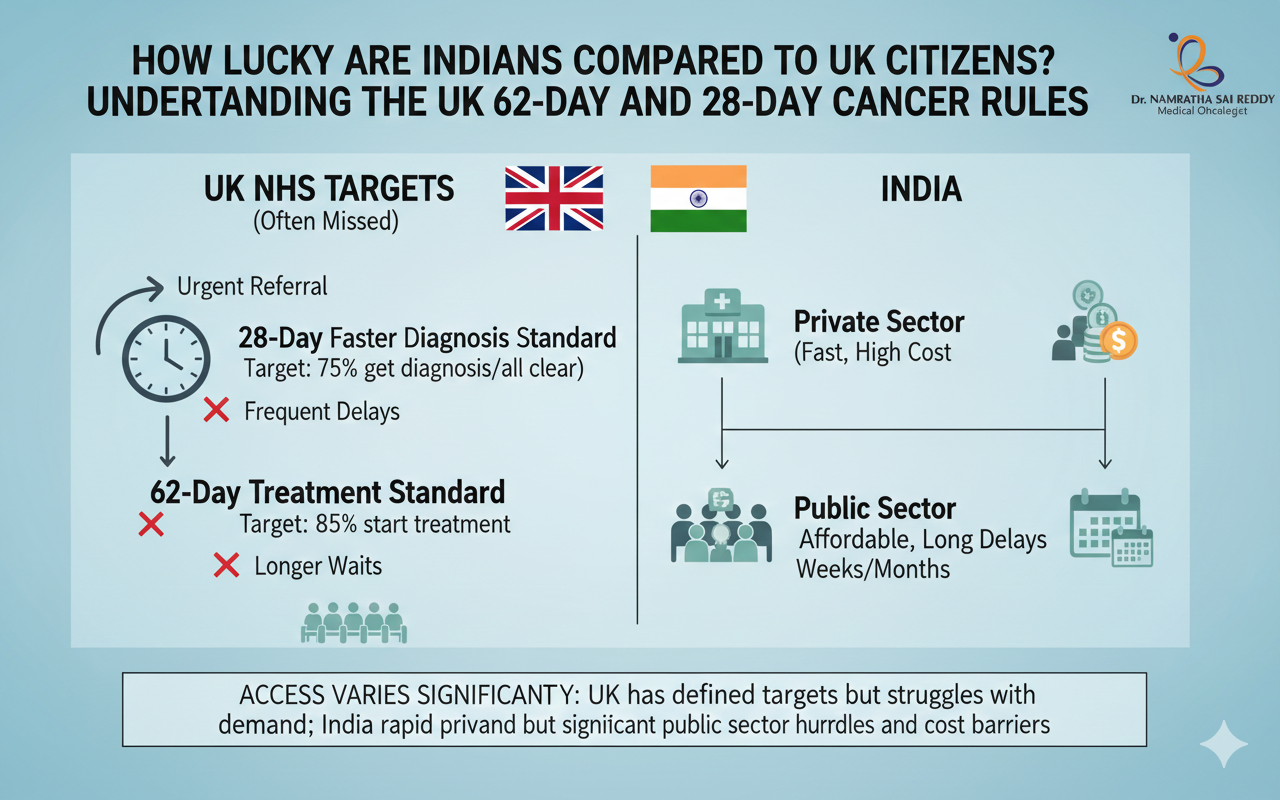
Cancer treatment in India vs UK reveals a striking difference in how quickly patients receive life-saving care. While the UK’s NHS operates under targets like the 28-day diagnosis rule and the 62-day treatment rule, many patients still face long waiting times. In contrast, cancer treatment in India vs UK comparisons show that treatment in India’s private healthcare system often begins within a median of about 20 days, sometimes even within a week in leading metropolitan hospitals.
Cancer Treatment in India vs UK: Why Treatment Starts Faster in India
Indians with access to quality healthcare are significantly more fortunate than UK citizens when it comes to cancer treatment speed. While the UK’s National Health Service mandates a 28-day diagnosis and 62-day treatment start timeline (which only 70% of patients actually meet), India’s private healthcare system delivers cancer treatment within a median of 20 days, often within just 7 days in top metropolitan hospitals. Our patients have the time to take 2-3 opinions, while patients in the UK wait to start their treatment during that time.
India’s $8.71 billion medical tourism industry, treating 7.3 million international patients annually, demonstrates the superior speed, affordability, and quality of care available in Indian cancer centres.
Key Takeaways
- Faster Treatment: India’s median cancer treatment starts ~20 days vs the UK’s 62-day target (only ~70% met)
- Strong Outcomes: Leading Indian cancer centres report 60–95% success rates, depending on cancer type & stage
- Major Cost Edge: 60–80% lower cost than UK private care, without compromising quality
- Global Care Hub: 7.3 million medical tourists (2024) – oncology among the top specialities
- International Trust: 57–61 Joint Commission International hospitals and 4,650+ NABH accredited centres
What Are the UK’s Cancer Waiting Time Rules?
The UK National Health Service established three cancer waiting time standards in October 2023 to ensure timely diagnosis and treatment:
The 28-Day Faster Diagnosis Standard
Patients must receive a definitive cancer diagnosis or have cancer ruled out within 28 days of an urgent suspected cancer referral. Target: 75% of patients (increasing to 80% by March 2026).
The 62-Day Referral to Treatment Standard
Patients must begin cancer treatment within 62 days from when hospitals receive urgent suspected cancer referrals from GPs, screening programs, or consultant upgrades. Target: 85% of patients.
The 31-Day Decision to Treat Standard
Patients should start treatment within 31 days of diagnosis and the decision to treat. Target: 96% of patients.
The Harsh Reality: UK NHS Failing Its Cancer Patients
The UK’s cancer waiting time standards exist on paper, but the reality tells a starkly different story:
Current UK Performance (November 2025)
- 28-Day Standard: Only 76.5% met (barely above 75% target)
- 62-Day Standard: Only 70.2% met (far below 85% target)
- This means nearly 30% of UK cancer patients wait MORE than 62 days to start treatment
UK’s Decade-Long Failure
The 62-day cancer treatment target has not been met since December 2015, that’s nearly a decade of continuous failure. The 18-week treatment target for elective procedures has not been met since 2016.
The Human Cost
The NHS waiting list stood at 7.31 million cases in November 2025, with approximately 154,000 patients waiting over a year for treatment. Real UK patients report:
- Waiting 6+ months from diagnosis to surgery
- Cancelled operations due to equipment failures
- No communication or support during waits
- Advanced cancer progression while waiting
India’s Cancer Healthcare Revolution: Speed, Quality, and Affordability
Lightning-Fast Treatment Timelines
India’s private healthcare system operates at a speed UK patients can only dream of:
Median Time to Treatment: 20 days from diagnosis, with patients receiving treatment within 7-39 days in private facilities
Top Hospital Performance: Major metropolitan hospitals in Delhi, Mumbai, Chennai, Bangalore, and Hyderabad often begin treatment within days of diagnosis.
Government Initiative Impact: Patients enrolled under PM-JAY health insurance saw 90% improvement in timely treatment access, and those diagnosed after 2018 had 36% higher odds of getting treatment within 30 days
World-Class Success Rates
Indian cancer centres deliver outcomes matching or exceeding global standards:
- Tata Memorial Hospital: 60-70% success rate for early-stage cancers, treating over 70,000 new patients annually
- Apollo Proton Cancer Centre: Success rates of up to 95% for certain cancers using proton therapy
- Medanta: 85% success rate for bone marrow transplants, having performed over 1,000 successful procedures
- Breast Cancer: 66.4% 5-year survival rate in India
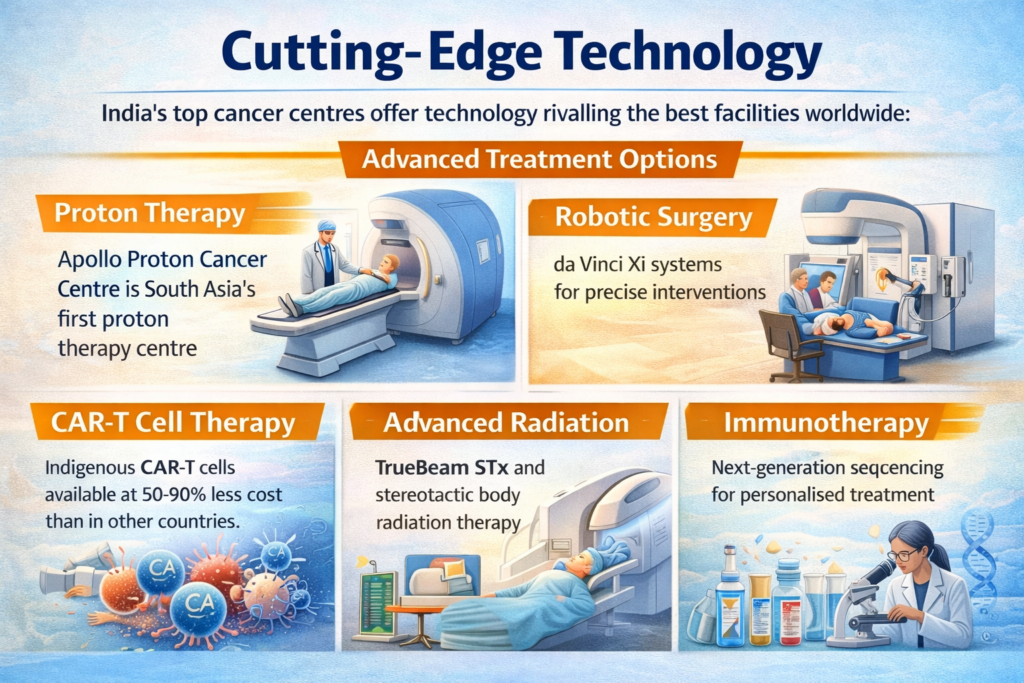
Cutting-Edge Technology
India’s top cancer centres offer technology rivalling the best facilities worldwide:
Advanced Treatment Options:
- Proton Therapy: Apollo Proton Cancer Centre is South Asia’s first proton therapy centre
- CAR-T Cell Therapy: Indigenous CAR-T cellsare available at 50-90% less cost than in other countries
- Robotic Surgery: da Vinci Xi systems for precise interventions
- Advanced Radiation: TrueBeam STx and stereotactic body radiation therapy
- Immunotherapy: Next-generation sequencing for personalised treatment
India: The Global Cancer Treatment Destination
Massive Medical Tourism Growth
India’s medical tourism market was valued at $7.69 billion in 2024, with around 7.3 million foreign patients coming to the country for treatment. This is expected to reach $8.71 billion in 2025 and $58 billion by 2035.
Cancer Treatment Leadership: Oncology is advancing at a 16.73% CAGR through 2031, led by proton therapy and CAR-T cell platforms
Why Patients Choose India Over the UK
Study of 2,835 International Cancer Patients (55 countries, November 2013 – April 2019):
The two most prominent reasons for overseas treatment were unreliable medical service at home or in nearby countries and the non-availability of medical services in the home country
Key Factors:
- Cost effectiveness: A significant factor for 73% of respondents
- 84.8% influenced by perception of India’s capacity to provide cancer treatment
- 88.6% influenced by perceived quality of care
- 82.1% influenced by the availability of skilled and experienced health workers
Remarkable Cost Advantage
India’s medical tourism market beneficiaries pay 60-80% less than OECD rates, with bypass grafts starting at USD 5,000 against USD 100,000 in the United States
Cancer Treatment Cost Comparison:
- Chemotherapy cycles: 60-80% cheaper than UK/US
- Radiation therapy: Fraction of Western costs
- Surgical procedures: Under $10,000 vs. $50,000+ abroad
- CAR-T therapy: 50-90% less than in other countries
India’s Quality Assurance: International Standards
Government Support Infrastructure
Streamlined Access:
- E-medical visa procedures cut approval times from 7-10 days to 2-3 days in emergency cases
- Medical value travel portal slashed visa approval to 48-72 hours with access to 167 countries
- “Heal in India” is a government initiative promoting medical tourism
- Special medical tourism zones
How Indians Compare to UK Citizens: The Verdict
If You’re in Metropolitan India: Significantly More Fortunate
Advantages:
- Treatment starts in 7-20 days vs the UK’s 62+ days (if you’re in the 30% who exceed targets)
- World-class technology, including proton therapy, CAR-T, and robotic surgery
- 60-95% success rates at top hospitals
- Cost 60-80% lower than UK private healthcare
- No waiting lists of 7.3 million people
- Government insurance providing 90% improvement in access
- International recognition attracting 7.3 million medical tourists
If You Have Health Insurance or Can Afford Private Care
You have access to cancer treatment that is:
- Faster than the UK NHS
- Comparable in quality to the best UK private hospitals
- Significantly more affordable
- Using the latest global technology
- Delivered by internationally trained specialists
The UK Advantage: Universal Coverage (But At What Cost?)
The UK’s NHS provides universal access regardless of ability to pay, a significant advantage. However, this comes with:
- Decade-long failure to meet cancer targets
- 7.3 million waiting list
- 30% of patients are waiting over 62 days
- Limited technology compared to the Indian private centres
- No guarantee of cutting-edge treatments
Why Treatment Delays Kill: The Critical Importance of Speed
Delays of more than 3 months in breast cancer can decrease survival by 10-20%, while delays over 60 days in head and neck cancers can reduce 5-year survival by almost 30%
The Math is Brutal:
- UK: 30% of patients wait over 62 days
- India (private): Most patients treated within 20 days
- Survival difference: 10-30% based on delay length
India’s Challenges: Room for Improvement
While India’s private healthcare excels, challenges remain:
Geographic Disparity
Rural areas still lack adequate cancer screening and treatment facilities, requiring patients to travel to metropolitan centres.
Public Healthcare Capacity
Government hospitals face capacity constraints, though PM-JAY insurance is bridging this gap.
Awareness and Early Detection
A hospital-based study from northern India showed that 90% of patients with lung cancer were diagnosed at an advanced stage
Ongoing Improvements:
- Expansion of cancer centres to tier-2 cities
- Government-funded screening programs
- Telemedicine for rural consultation
- Mobile cancer detection units
Source: Cancer Statistics 2020 Report – JCO Global Oncology
What This Means for Patients and Policymakers
India’s cancer care advantage lies in action, not aspiration. While countries like the UK have well-defined waiting-time targets, persistent delays continue to impact real-world outcomes. India, on the other hand, is delivering faster treatment initiation, globally comparable technology, strong survival outcomes, and affordable access at scale.
For patients, this means earlier treatment and more choice. For policymakers and health systems, it reinforces a critical lesson: speed, access, and execution matter as much as guidelines. India’s model shows that timely, high-quality cancer care is achievable when systems are designed around outcomes, not just targets.
FAQs
1. What is the UK 62-day cancer rule?
It is an NHS target to start cancer treatment within 62 days of an urgent referral for suspected cancer.
2. Is the UK meeting the 62-day target consistently?
No. Only about 70% of patients start treatment within this timeframe, below the 85% target.
3. How fast does cancer treatment start in India?
In many leading centres, treatment begins in a median of ~20 days, often faster for high-risk cancers.
4. Are cancer outcomes in India comparable to those in Western countries?
Yes. Top Indian cancer centres report 60–95% success rates, depending on cancer type and stage.
5. Why is cancer treatment cheaper in India?
Lower infrastructure costs, efficient care delivery, and bundled pricing make treatment 60–80% cheaper than UK private care.
6. Does India offer advanced cancer technologies?
Yes. India provides proton therapy, CAR-T cell therapy, robotic surgery, and precision oncology at global standards.
7. Is cancer care in India internationally accredited?
Yes. India has dozens of JCI-accredited hospitals and 4,650+ NABH-accredited centres, ensuring quality and safety.