

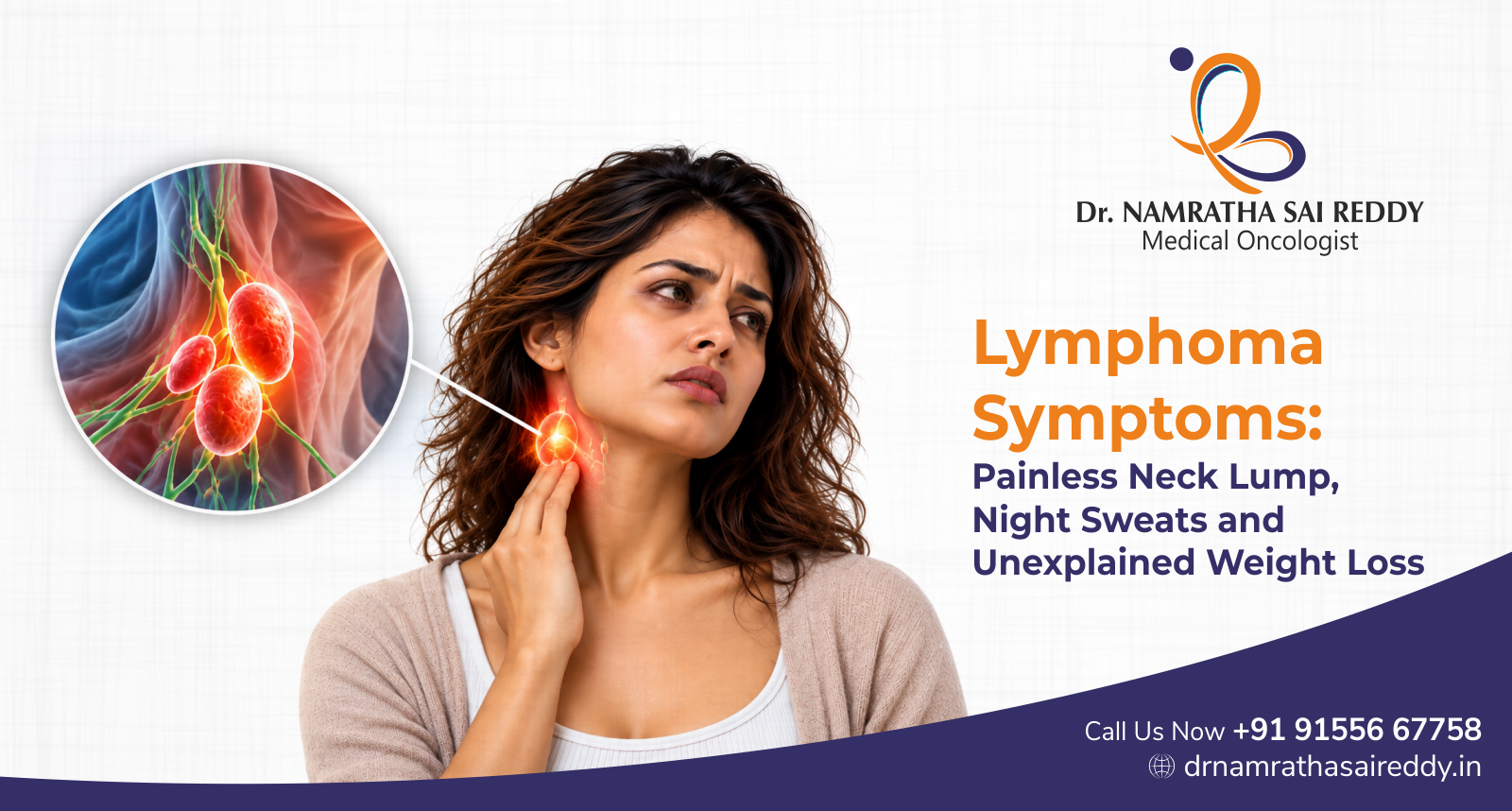
A lump in the neck that does not hurt. Night sweats that soak through clothing and bedding. Weight loss that happens without any change in diet or exercise. Together, and particularly when they persist, they form one of the most recognisable symptom clusters in oncology: the classic presentation of lymphoma. Yet despite this, lymphoma is frequently diagnosed late. This article explains what lymphoma symptoms look like, why certain ones get missed, what the different types of lymphoma mean for your prognosis, and when a swollen lymph node needs to be taken seriously. For related reading, see our articles on multi-cancer early detection blood tests and understanding survivorship care after cancer treatment.
Key Takeaways
- Lymphoma is a cancer of the lymphatic system and is among the most common cancers in both adults and younger age groups.
- The classic symptom triad is a painless enlarged lymph node (most often in the neck, armpit, or groin), drenching night sweats, and unexplained weight loss of more than 10% of body weight over six months.
- These symptoms together are known as B symptoms in lymphoma staging and carry prognostic significance.
- Painless lymph nodes are commonly dismissed because the absence of pain suggests to most people that the swelling is not serious. In lymphoma, the opposite is often true.
- Lymphoma is one of the more treatable cancers, with many forms having high remission and cure rates, particularly when diagnosed early.
- Diagnosis requires a lymph node biopsy; imaging alone is insufficient to confirm lymphoma.
What Is Lymphoma and How Does It Develop?
Lymphoma is a cancer that originates in lymphocytes, a type of white blood cell that plays a central role in the immune system. When lymphocytes undergo malignant transformation, they can accumulate in lymph nodes and other lymphatic tissues, causing the swelling and systemic effects that characterise lymphoma.
Hodgkin lymphoma (HL): Characterised by the presence of Reed-Sternberg cells. It tends to spread in a predictable, contiguous pattern and is highly responsive to treatment, with cure rates exceeding 85 to 90% in early-stage disease.
Non-Hodgkin lymphoma (NHL): A much larger and more heterogeneous group, encompassing over 60 distinct subtypes with widely varying behaviour. NHL accounts for roughly 90% of all lymphoma diagnoses. According to the World Health Organization, lymphoma collectively accounts for approximately 4 to 5% of all new cancer diagnoses globally.
For context on why cancer cases are rising in younger adults, including blood cancers, see our article: Why Cancer Cases Are Increasing in Younger Adults.
What Are the Symptoms of Lymphoma?
Lymph Node Symptoms
- Painless swelling of one or more lymph nodes, most commonly in the neck, armpits, or groin
- A lump or mass in the abdomen (from enlarged abdominal lymph nodes or spleen)
- A feeling of pressure or fullness in the abdomen
- Persistent cough, breathlessness, or chest discomfort from enlarged mediastinal lymph nodes
- Leg swelling from enlarged pelvic or inguinal lymph nodes obstructing lymphatic drainage
B Symptoms (Systemic Symptoms)
The following three symptoms are formally designated as B symptoms in lymphoma staging and carry prognostic weight:
- Drenching night sweats: Sweating severe enough to soak through nightclothes and bedding, distinct from ordinary warmth-related sweating
- Unexplained weight loss: Loss of more than 10% of body weight over six months without dieting or increased physical activity
- Unexplained fever: Recurrent fevers above 38 degrees Celsius without infection
Other Commonly Reported Symptoms
- Persistent, generalised itching (pruritus) without rash, more characteristic of Hodgkin lymphoma
- Fatigue that is disproportionate to activity level and does not improve with rest
- Easy bleeding or bruising when the bone marrow is involved
- Recurrent infections when normal white blood cell production is disrupted
- Pain in lymph nodes after drinking alcohol, a rare but specific finding in Hodgkin lymphoma
Why Is a Painless Neck Lump So Often Dismissed?
Most people associate pain with disease severity. A lymph node that swells in response to infection is typically tender, appears suddenly, and resolves within two to four weeks. A lymphomatous node, by contrast, tends to be painless, firm, rubbery in texture, and gradually enlarging over weeks to months.
The clinical rule of thumb: an enlarged lymph node that has been present for more than four weeks, is growing rather than shrinking, is hard or rubbery rather than soft, or is accompanied by any B symptom warrants investigation beyond simple observation.
Who Is at Highest Risk for Lymphoma?
- Age: Hodgkin lymphoma has peaks in young adults (15 to 35) and older adults (over 55). Non-Hodgkin lymphoma risk increases steadily with age, with median diagnosis in the mid-60s.
- Immune suppression: People who are immunocompromised due to HIV infection, organ transplantation, or autoimmune disease treatment have substantially elevated lymphoma risk.
- Epstein-Barr virus (EBV) infection: EBV is implicated in several lymphoma subtypes, including Hodgkin lymphoma and Burkitt lymphoma.
- Helicobacter pylori infection: Associated with gastric MALT lymphoma.
- Family history: A first-degree relative with lymphoma increases personal risk, though most cases are sporadic.
- Autoimmune disease: Conditions such as rheumatoid arthritis, Sjogren’s syndrome, and systemic lupus erythematosus are associated with elevated NHL risk.
- Certain occupational chemical exposures: Prolonged exposure to pesticides, herbicides, and solvents such as benzene.
What Are the Early Signs of Lymphoma to Watch For?
- A lump in the neck, armpit, or groin that is not painful, not associated with a recent illness, and does not shrink within three to four weeks
- Unusual fatigue that feels qualitatively different from ordinary tiredness and persists for weeks
- Night sweats that are drenching rather than simply warm, occurring on multiple nights per week
- Gradual, unintentional weight loss noticed over one to three months
- Persistent low-grade fever or recurrent fevers without a clear infectious cause
- Itching over the skin, particularly on the trunk or legs, without rash or obvious skin irritation
- A sensation of abdominal fullness or pressure, particularly in the left upper abdomen (enlarged spleen)
How Is Lymphoma Diagnosed and Staged?
Diagnosis always requires tissue, which means a lymph node biopsy is essential. No combination of imaging and blood tests alone is sufficient to confirm lymphoma. For a broader look at how blood-based cancer detection is evolving, see our article on liquid biopsy in cancer detection. For context on how AI tools are supporting cancer diagnosis, see AI in cancer detection and treatment.
- Lymph node biopsy: An excisional biopsy (removal of an entire lymph node) is strongly preferred for initial diagnosis as it preserves the lymph node architecture critical for accurate subtyping.
- Blood tests: Full blood count (FBC), lactate dehydrogenase (LDH), uric acid, comprehensive metabolic panel, and HIV and hepatitis serology.
- CT scan of the chest, abdomen, and pelvis: Standard staging imaging to assess the extent and distribution of lymph node involvement.
- PET-CT scan: Now the preferred staging modality for most lymphoma subtypes.
- Bone marrow biopsy: Performed to assess whether lymphoma has involved the bone marrow.
- Molecular and genetic profiling: Used particularly for aggressive NHL subtypes to guide treatment selection.
How Is Lymphoma Treated?
Hodgkin Lymphoma
- The standard first-line regimen is ABVD chemotherapy (doxorubicin, bleomycin, vinblastine, dacarbazine), usually combined with radiation for early-stage disease.
- Brentuximab vedotin, an antibody-drug conjugate targeting CD30, has improved outcomes in advanced-stage Hodgkin lymphoma.
- PD-1 checkpoint inhibitors (nivolumab, pembrolizumab) are highly effective in relapsed or refractory Hodgkin lymphoma.
Non-Hodgkin Lymphoma
- Aggressive subtypes such as DLBCL are treated with curative intent using R-CHOP (rituximab plus cyclophosphamide, doxorubicin, vincristine, prednisone).
- Indolent subtypes such as follicular lymphoma may be managed with watchful waiting or anti-CD20 antibody-based therapy when treatment is needed.
- CAR-T cell therapy is now approved for relapsed or refractory DLBCL and other aggressive B-cell lymphomas.
- Stem cell transplantation (autologous or allogeneic) remains an important option for relapsed or high-risk lymphoma.
For more on managing the side effects of chemotherapy used in lymphoma treatment, see: Common Chemotherapy Side Effects and How to Manage Them.
Is This the Right Concern for You?
A painless lump that persists, unexplained weight loss, or drenching night sweats are symptoms that warrant evaluation. Consult Dr. Namratha Sai Reddy’s clinic if you or a loved one is experiencing:
- A painless neck, armpit, or groin lump that has been present for more than four weeks
- Unexplained weight loss, drenching night sweats, or recurrent fevers
- Persistent fatigue or generalised itching without an obvious cause
- Abdominal fullness or pressure with no gastrointestinal diagnosis
- An abnormal blood count or elevated LDH found on routine testing
When Should Lymphoma Patients Seek Urgent Medical Care?
- Rapidly enlarging neck mass causing difficulty breathing or swallowing
- Superior vena cava syndrome: facial swelling, arm swelling, and difficulty breathing from a mediastinal mass
- Severe infection or high fever in someone receiving chemotherapy (febrile neutropenia) — this is a medical emergency
- Sudden severe abdominal pain (possible spleen rupture or bowel obstruction)
- New neurological symptoms: confusion, weakness, vision changes, or severe headache
- Uncontrolled bleeding or signs of very low platelet count
If any of these occur, go to the nearest emergency department or call emergency services immediately.
Medical References
- Swerdlow SH, et al. WHO Classification of Tumours of Haematopoietic and Lymphoid Tissues. 5th edition, IARC Press, 2022. PubMed.
- National Comprehensive Cancer Network (NCCN). Clinical Practice Guidelines in Oncology: B-Cell Lymphomas. Version 2025.
- Cheson BD, et al. Recommendations for Initial Evaluation, Staging, and Response Assessment of Hodgkin and Non-Hodgkin Lymphoma: The Lugano Classification. Journal of Clinical Oncology, 2014.
- Ansell SM. Hodgkin Lymphoma: A 2020 Update on Diagnosis, Risk-Stratification, and Management. American Journal of Hematology, 2020. PubMed.
- Sehn LH, Salles G. Diffuse Large B-Cell Lymphoma. New England Journal of Medicine, 2021. PubMed.
- Lymphoma Research Foundation. Understanding Lymphoma: Signs and Symptoms. 2023.
Frequently Asked Questions
1. What are the first signs of lymphoma?
The most common early signs are a painless swollen lymph node (most often in the neck, armpit, or groin), unexplained fatigue, drenching night sweats, and unintentional weight loss.
2. Why are lymphoma lumps painless?
Unlike nodes enlarged by infection, lymphomatous nodes tend not to cause pain because they grow slowly and do not trigger the same acute inflammatory response.
3. What are B symptoms in lymphoma?
B symptoms are drenching night sweats, unexplained fever above 38 degrees Celsius, and unexplained weight loss of more than 10% of body weight over six months. Their presence at diagnosis carries prognostic significance.
4. Is a painless neck lump always lymphoma?
No. Most painless neck lumps are benign. However, a neck lump that has been present for more than four weeks, is growing, is firm or rubbery, or is accompanied by B symptoms warrants medical evaluation.
5. What is the difference between Hodgkin and non-Hodgkin lymphoma?
Hodgkin lymphoma is defined by the presence of Reed-Sternberg cells and tends to affect younger adults with a very high cure rate. Non-Hodgkin lymphoma is a broad category of over 60 subtypes, far more common overall.
6. Can lymphoma be cured?
Many forms of lymphoma are curable. Hodgkin lymphoma has a cure rate exceeding 85% in early stages. Many aggressive NHL subtypes are also curable with standard chemotherapy regimens.
7. How is lymphoma diagnosed?
Lymphoma is diagnosed by biopsy of an enlarged lymph node, followed by imaging (usually PET-CT) for staging. Blood tests, bone marrow biopsy, and molecular profiling are also part of the standard workup.
8. How long can someone have lymphoma without knowing?
Indolent (slow-growing) lymphomas can be present for years before causing enough symptoms to prompt evaluation. Aggressive lymphomas typically cause symptoms within weeks to months of onset.
9. Is night sweating always a sign of lymphoma?
No. Night sweats are common and have many causes including menopause, infection, anxiety, and medications. Lymphoma-related night sweats are typically drenching and occur repeatedly alongside other symptoms.
10. What should I do if I have a painless lump in my neck?
If the lump has been present for more than four weeks, is growing, is not clearly associated with a recent infection, or is accompanied by weight loss, night sweats, or fever, see your doctor.
This article is for informational purposes and does not replace professional medical advice. Always consult your oncologist before making decisions about your diagnosis or treatment plan.