
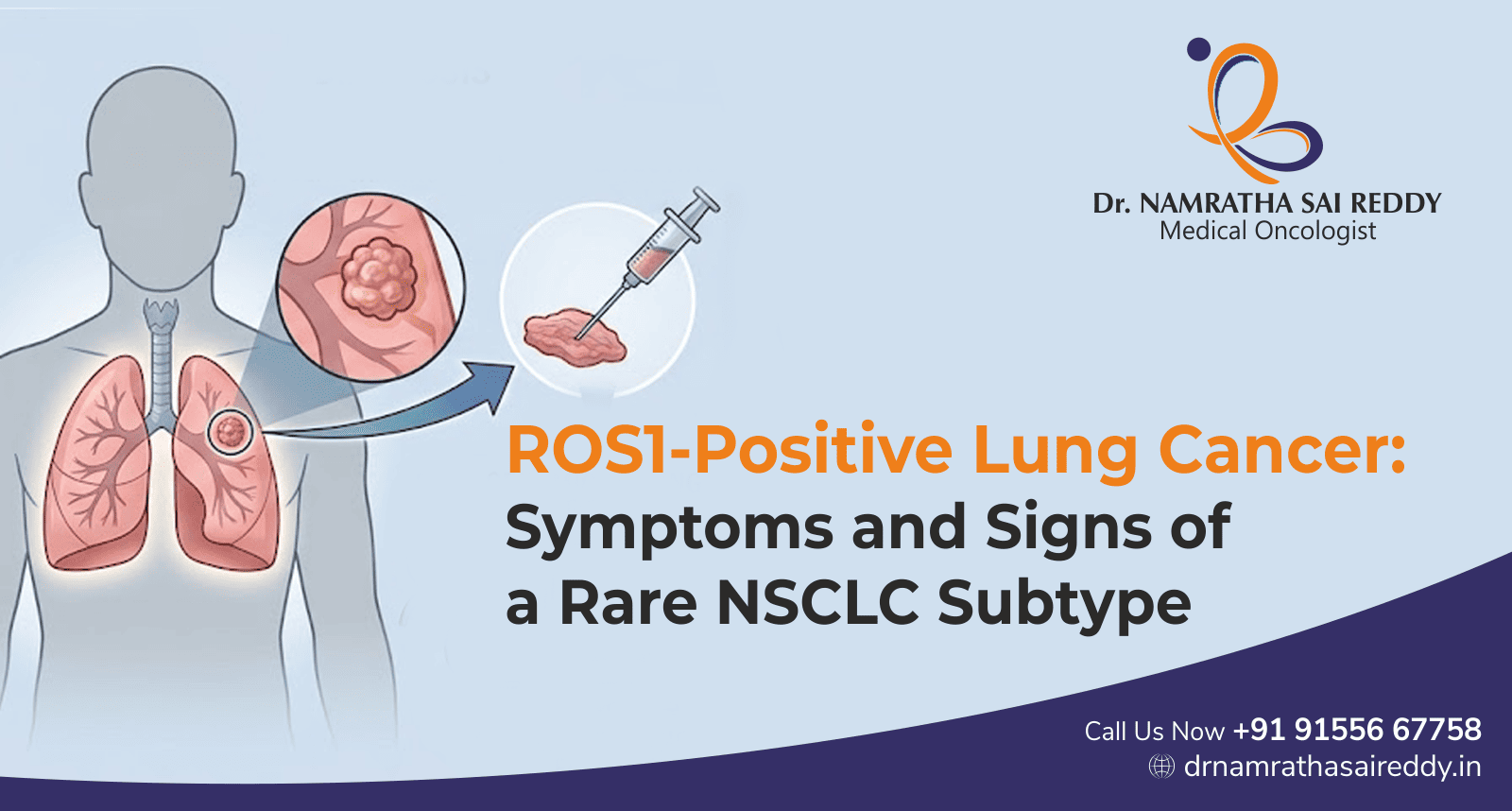
ROS1-positive non-small cell lung cancer (NSCLC) is a rare, genetically distinct form of lung cancer that behaves differently from typical smoking-related lung cancers. It tends to affect younger adults, often non-smokers, and its symptoms can be easy to miss or mistake for something less serious. If you’re trying to understand what ROS1-positive lung cancer looks like, from early warning signs to the newest treatment advances, this guide walks through what to watch for and when to see a doctor. For related context, see our articles on why more non-smokers are being diagnosed with lung cancer and what MRD testing means for cancer monitoring.
Key Takeaways
• ROS1-positive NSCLC occurs when the ROS1 gene fuses with another gene, driving uncontrolled cell growth. It accounts for up to 3% of all NSCLC cases.
• It typically affects non-smokers in their 40s and 50s, which makes it easy to overlook since it doesn’t fit the classic lung cancer risk profile.
• Early symptoms often overlap with common respiratory issues, including persistent cough, chest discomfort, and shortness of breath.
• ROS1-positive NSCLC frequently spreads to the brain, so neurological symptoms like headaches or dizziness can also be an early sign.
• A newly approved targeted therapy, zidesamtinib (Jideytro), offers a next option for patients whose cancer has progressed after a prior ROS1 inhibitor.
• Diagnosis depends on molecular testing (biomarker testing) of the tumor, not just imaging, so ask specifically about ROS1 testing if lung cancer is suspected.
What Is ROS1-Positive Non-Small Cell Lung Cancer?
Non-small cell lung cancer (NSCLC) is the most common form of lung cancer overall, and within it, a small subset of tumors are driven by a specific genetic abnormality called a ROS1 gene fusion. This happens when the ROS1 gene fuses with part of another gene, causing the resulting protein to send constant “grow” signals to the cell, which leads to uncontrolled tumor growth. ROS1-positive NSCLC tends to be more aggressive than average and has a strong tendency to spread to the brain. Roughly 50,000 people worldwide are diagnosed with this subtype each year, and it’s notably common in people who have never smoked, which often delays diagnosis since lung cancer isn’t the first thing patients or even doctors initially suspect.
1. What Are the Early Symptoms of ROS1-Positive Lung Cancer?
Because ROS1-positive NSCLC tends to occur in younger, non-smoking adults, early symptoms are frequently dismissed as a lingering cold, allergies, or stress-related fatigue. Recognizing the pattern early can make a meaningful difference in how quickly treatment starts.
• A cough that persists for more than three weeks, especially if it’s new or has changed in character.
• Chest pain or discomfort that worsens with deep breathing, coughing, or laughing.
• Shortness of breath during activities that didn’t previously cause breathlessness.
• Coughing up blood or blood-tinged mucus, even in small amounts.
• Unexplained fatigue or a general sense of being unwell that doesn’t improve with rest.
Can Lung Cancer Cause Symptoms Even in People Who Have Never Smoked?
Yes, and this is one of the most important myths to correct about ROS1-positive lung cancer specifically. Because this subtype is driven by a gene fusion rather than tobacco exposure, it occurs disproportionately in lifelong non-smokers, often in their 40s and 50s. Patients and even clinicians can be slow to consider lung cancer in this group precisely because the traditional smoking-related risk factors are absent, which is why persistent respiratory symptoms in a non-smoker should not be automatically ruled out as low risk.
2. Can ROS1-Positive Lung Cancer Cause Symptoms in the Brain or Nervous System?
Yes. ROS1-positive NSCLC has a strong tendency to spread to the brain, and in some cases, neurological symptoms appear before the lung symptoms are even noticed.
• New or worsening headaches, particularly ones that are worse in the morning.
• Dizziness, balance problems, or unexplained falls.
• Vision changes, such as blurred or double vision.
• New onset seizures in someone with no prior seizure history.
• Subtle changes in memory, mood, or personality noticed by family members.
Because brain involvement is common in this subtype, newer targeted drugs are specifically designed with the ability to cross the blood-brain barrier to control disease in the brain, which was a major limitation of some earlier treatments.
3. Why Does ROS1-Positive Lung Cancer Often Affect Non-Smokers and Younger Adults?
This is one of the defining, and most confusing, features of ROS1-positive NSCLC. Unlike most lung cancers, which are strongly linked to cumulative tobacco exposure, ROS1 fusions arise from a specific genetic event within the tumor and are not caused by smoking history. This is part of a broader pattern researchers have observed of lung cancer rising among lifelong non-smokers, tied to gene fusions and mutations rather than external carcinogen exposure.
• If you’re a non-smoker with persistent respiratory symptoms, mention this clearly to your doctor rather than assuming lung cancer is unlikely.
• Ask about biomarker or molecular testing specifically, since routine imaging alone won’t identify a ROS1 fusion.
• Family history of lung cancer in non-smokers is worth mentioning during evaluation, even though ROS1 fusions themselves are not typically inherited.
4. What Are the Warning Signs That ROS1-Positive Lung Cancer Is Progressing or Resistant to Treatment?
Patients already being treated for ROS1-positive NSCLC with a targeted therapy (a ROS1 tyrosine kinase inhibitor) should watch for signs that the cancer is progressing or has developed resistance to that drug.
• Return or worsening of symptoms that had previously improved on treatment, such as cough or shortness of breath.
• New neurological symptoms, which can indicate the cancer has progressed in the brain even if body scans look stable.
• New bone pain, which can signal spread to the skeleton.
• Unexplained weight loss or appetite changes despite otherwise stable treatment.
If resistance develops, newer options are now available. On July 22, 2026, the FDA approved zidesamtinib (Jideytro), a next-generation, brain-penetrant ROS1 inhibitor, for patients whose ROS1-positive NSCLC has already been treated with a prior ROS1 inhibitor. In its pivotal trial, zidesamtinib produced a response in 44% of previously treated patients, including meaningful responses in those with brain metastases and known resistance mutations. Full details are available from the FDA’s official approval announcement.
Does Cancer Progression Always Mean a Treatment Has Failed Completely?
No. Progression on one ROS1 inhibitor doesn’t mean targeted therapy is no longer an option. It often means the cancer has developed a specific resistance mutation, and newer drugs like zidesamtinib are designed specifically to remain effective against many of these resistance patterns. This is why retesting the tumor at the time of progression is valuable: it helps identify which next-line treatment is most likely to work.
How Is ROS1-Positive Lung Cancer Diagnosed?
Diagnosing ROS1-positive NSCLC requires more than a standard scan. It depends on identifying the specific gene fusion driving the cancer.
• Imaging such as chest X-ray, CT, or PET-CT to locate and characterize the tumor.
• Biopsy to obtain tumor tissue for pathology review.
• Molecular or biomarker testing, including next-generation sequencing (NGS) or fluorescence in situ hybridization (FISH), to specifically identify a ROS1 gene fusion.
• Brain MRI, often included at diagnosis given how frequently this subtype spreads to the brain.
• Liquid biopsy (blood-based testing), which can sometimes detect ROS1 fusions or resistance mutations without a repeat tissue biopsy.
Early signs worth flagging to your doctor include a persistent cough lasting more than three weeks, unexplained shortness of breath, coughing up blood, and new neurological symptoms such as headaches or vision changes, particularly in someone who has never smoked.
What to avoid: Don’t dismiss persistent respiratory or neurological symptoms simply because you don’t smoke or don’t fit the “typical” lung cancer profile. Don’t delay molecular testing if NSCLC is diagnosed. Confirming ROS1 status (and not just treating it as generic lung cancer) directly determines which targeted therapies are available to you.
When Should You Be Evaluated for Possible ROS1-Positive Lung Cancer?
Because ROS1-positive lung cancer often appears in people without the usual risk factors, it’s easy for symptoms to be brushed aside for too long. If you have persistent respiratory symptoms, especially alongside neurological changes, it’s worth a dedicated evaluation rather than waiting to see if things resolve on their own.
Consult Dr. Namratha Sai Reddy’s clinic if you or a loved one is experiencing:
• A cough lasting more than three weeks, with or without blood
• Unexplained shortness of breath or chest discomfort
• New headaches, dizziness, or vision changes alongside respiratory symptoms
• A confirmed NSCLC diagnosis without molecular or biomarker testing yet performed
• Disease progression on an existing ROS1 inhibitor
Call +91 91556 67758 or book an appointment online to schedule a consultation.
What Are the Warning Signs That Need Urgent Medical Attention?
Certain symptoms in a patient with known or suspected ROS1-positive lung cancer should not wait for a routine appointment.
• Coughing up a significant amount of blood
• Sudden, severe shortness of breath
• A new seizure
• Sudden severe headache, confusion, or loss of consciousness
• Sudden weakness or numbness on one side of the body
If any of these occur, go to the nearest emergency department or call emergency services immediately.
Medically Reviewed & Approved By
Dr. B. Namratha Sai Reddy
Medical Oncologist, American Oncology Institute, Nallagandla, Hyderabad
Medical References
1. U.S. Food and Drug Administration. FDA approves zidesamtinib for ROS1-positive non-small cell lung cancer. Published July 22, 2026.
2. GSK. Jideytro (zidesamtinib) approved in the US for previously treated ROS1-positive non-small cell lung cancer. Press release, July 22, 2026.
3. The ASCO Post. FDA Approves Zidesamtinib for Second-Line Treatment of ROS1-Positive NSCLC. July 2026.
4. Drugs.com. Jideytro (zidesamtinib) FDA Approval History.
5. Oncology Nursing Society. FDA Approves Zidesamtinib for Second-Line Treatment of ROS1-Positive NSCLC. July 2026.
Frequently Asked Questions
1. What does ROS1-positive mean in lung cancer?
It means the tumor’s growth is driven by a fusion between the ROS1 gene and another gene, which causes uncontrolled cell growth. It’s identified through molecular or biomarker testing, not standard imaging alone.
2. Who typically develops ROS1-positive lung cancer?
It most often affects younger adults, frequently in their 40s and 50s, and disproportionately occurs in people who have never smoked.
3. What are the first symptoms of ROS1-positive lung cancer?
Common early symptoms include a persistent cough, chest discomfort, shortness of breath, and unexplained fatigue. Because these overlap with common illnesses, they’re often initially dismissed.
4. Can ROS1-positive lung cancer cause neurological symptoms?
Yes. This subtype frequently spreads to the brain, so headaches, dizziness, vision changes, or new seizures can be early or later signs and should be evaluated promptly.
5. How is ROS1-positive lung cancer diagnosed?
Through a combination of imaging, tumor biopsy, and molecular testing (such as next-generation sequencing or FISH) that specifically identifies the ROS1 gene fusion.
6. What treatment options exist for ROS1-positive lung cancer?
Targeted ROS1 inhibitors are the standard approach. If the cancer progresses on one, newer options such as zidesamtinib (approved in July 2026) are designed to work against many resistance mutations and to control disease in the brain.
7. Is ROS1-positive lung cancer curable?
It’s generally managed as a chronic, treatable cancer rather than a curable one, though targeted therapies can produce long, durable responses, especially with newer brain-penetrant drugs.
8. Does a normal chest X-ray rule out ROS1-positive lung cancer?
Not necessarily. Early or small tumors may not always be visible on a plain X-ray, and identifying the ROS1 fusion itself requires molecular testing regardless of imaging findings.
9. Can quitting smoking prevent ROS1-positive lung cancer?
No. Since this subtype is driven by a genetic fusion rather than tobacco exposure, it can occur in people with no smoking history at all, which is part of why it’s often missed early.
10. When should someone see a doctor about possible ROS1-positive lung cancer symptoms?
Any persistent cough lasting more than three weeks, unexplained shortness of breath, coughing up blood, or new neurological symptoms warrant prompt evaluation, especially in someone without typical lung cancer risk factors.